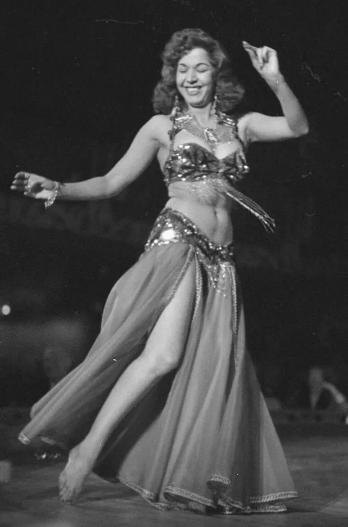
Samia Gamal
1924 – 1994
Her airy style, travelling steps and elegance left their mark on stage and screen. She remains a reference for fluidity and theatrical interpretation.
An introduction to Raq’s Sharqi and the golden age of Egyptian oriental dance.
The Arabic expression Raq’s Sharqi means “oriental dance”. Its Egyptian stage form developed in the first half of the twentieth century, at the intersection of local dance practices, music, theatre and cabaret performance.
Rather than a tradition unchanged since antiquity, it is a living art shaped by exchanges and transformations. Isolations, undulations, travelling steps and expressive gestures create a sensitive dialogue with music.
In Cairo, cabaret stages, particularly those associated with Badia Masabni, contributed to this evolution. Egyptian cinema then gave dancers visibility far beyond performance venues.
The term “golden age” generally refers to the rise of Raq’s Sharqi in cinema, particularly from the 1930s to the 1950s, followed by its wider influence in the mid-twentieth century. The chronological boundaries vary between authors.
Her airy style, travelling steps and elegance left their mark on stage and screen. She remains a reference for fluidity and theatrical interpretation.
A leading dancer and actress, she combined presence, musicality and grounded movement. Her interpretation was inseparable from her personality and charisma.
Coming from a performance background, she brought remarkable energy and virtuosity. Her dancing combined precision, vitality and stagecraft.
Soheir Zaki, Nagwa Fouad and other artists continued and renewed this legacy. Today, festivals, classes and international stages keep these repertoires alive, through both teaching and creation.
Sources: https://worlddanceheritage.org/